Bright Data review
Starting as a spinoff of a renowned VPN service called Hola more than a decade ago, Bright Data is among the best providers of proxy services on the market right now. The platform commands a massive ecosystem featuring 400+ million monthly rotating residential IPs and 1.3+ million static ISP and datacenter proxies each, spanning 195 countries.
Lately, the service has notably been pushing beyond “mere” proxy rotation into a complete web data platform equipped with AI-powered web unlockers, SERP and scraper APIs, and pre-collected structured datasets, to name a few things.
- Want to try Bright Data? Check out the website here
Plans and Pricing
Bright Data has quite a few products listed on its pricing page. Let’s start with proxies, namely residential, ISP, and datacenter variants.
Users pay for residential proxies according to the bandwidth they consume. Bright Data offers three standard plans, currently at a 50% discount for the first three months: $499 monthly for 141 GB, $999 monthly for 332 GB, and $1,999 monthly for 798 GB. Alternatively, you can choose the pay-as-you-go option starting at $4 per GB. The drawback is that the pay-as-you-go plan is slightly more expensive in the long run ($4 per GB compared to $3.5 per GB on the 141 GB plan). If you need more than 1 TB, you can reach out to the company for customized pricing.
For datacenter proxies, users can pay according to the number of IP addresses they require. The shared proxy plans (dedicated proxies are pricier) are 10 IPs at $14 per month ($1.4 per IP), 100 IPs at $100 per month ($1 per IP), 500 IPs for $475 per month ($0.95 per IP), and 1,000 IPs at $900 per month ($0.9 per IP). As with residential proxies, if these plans don’t meet your needs, you can contact the company for tailored pricing above 1,000 IPs. Users can also pay for datacenter proxies according to bandwidth. The standard plans are $499 monthly for 1 TB, $999 monthly for 2 TB, and $1,999 monthly for 5 TB. The pay-as-you-go option with no monthly commitment costs $0.6 per GB.
If you need ISP proxies, Bright Data has four plans to offer you: $18/month for 10 IPs ($1.8 per IP), $145/month for 100 IPs ($1.45 per IP), $700/month for 500 IPs ($1.4 per IP), and $1,300/month for 1,000 IPs ($1.3 per IP). You can also pay for ISP proxies according to bandwidth. Bright Data recently doubled the allowance, so now you pay $499 monthly for 71 GB, $999 monthly for 166 GB, and $1,999 monthly for 399 GB. The pay-as-you-go option also saw changes, with no monthly commitment costing $8 per GB.
Dedicated ISP IPs are a bit more expensive but follow the same structure. Similar to residential and datacenter plans, should you require over 1,000 IPs or 1 TB, you’ll need to check in with the Bright Data team directly.
It seems that Bright Data has slowly phased out mobile proxies from its proxy offer. Existing users with an active mobile proxy can continue to use the proxies, but the service is now unavailable to new signups and inactive accounts.
Bright Data offers sophisticated web access APIs with its Unlocker API pricing coming in four versions. First, the Free Tier (found in most products) grants you 5,000 requests per month. Then, there are three Scale plans: $499 monthly for 383,000 requests ($1.3 per 1,000 additional requests), $999 monthly for 908,000 requests ($1.1 per 1,000 additional requests), and $1,999 monthly for 2 million requests ($1 per 1,000 additional requests). The company also offers a custom pricing option for enterprise-level projects. If you don’t want a monthly commitment, you can choose the $1.5 per 1,000 results pay-as-you-go plan.
The Web Scraper API, SERP API, Crawl API, and Scraper Studio (AI-powered development environment for building and deploying custom scrapers) are identically priced, with tiny differences regarding the number of requests/page loads included. The Browser API pricing follows much the same sentiment, costing $499/month for 71 GB, $999/month for 166 GB, and $1,999/month for 399 GB. The no-commitment option is charged $8 per GB.
Bright Data also offers pre-built datasets, a unique feature that many proxy platforms don’t have. Starting at $250 per month for 100,000 records, these datasets allow businesses to access ready-made data instead of scraping it from scratch at higher costs. Available datasets include Amazon products, Yahoo Finance stock market data, Zillow real estate listings, LinkedIn profiles, and much, much more.
Finally, the Data Firehose product delivers a continuous, real-time stream of live web data, while Web Archive provides direct programmatic access to a 90 PB cached repository of the web. Pricing is based on the pay-as-you-go rate, starting at $0.20 per 1,000 HTMLs for Data Firehose and $1 per 1,000 HTML records for archived data. For projects with large data needs, long-term commitments, or multiple scrapers, volume discounts are available through Bright Data's team.
Features
Accessing Bright Data’s features starts with registration. To sign up as a new user, you’ll need a work email address, but the platform also supports logging in with Google and GitHub accounts. You'll receive a verification email after signing up and creating a password.
Residential Proxies
Bright Data offers proxy IP addresses sourced ethically from physical devices worldwide. This means that device owners (peers) explicitly opt in to share their idle bandwidth and IP addresses in exchange for perks like ad-free app experiences, cash payouts, or free premium software such as BrightVPN. Bright Data’s users can then choose one of the IPs to bypass geo-restrictions and scrape data.
Default proxy behavior rotates per request, though Bright Data also supports sticky sessions where the same residential IP is active for a specified duration, as well as custom AI-driven rotation rules. The platform offers more than 400 million ethically sourced residential proxies from 195 countries with precise country-, state-, city-, ZIP code-, and ASN-level targeting. The most popular locations are the United States, Brazil, India, Germany, the United Kingdom, and China.
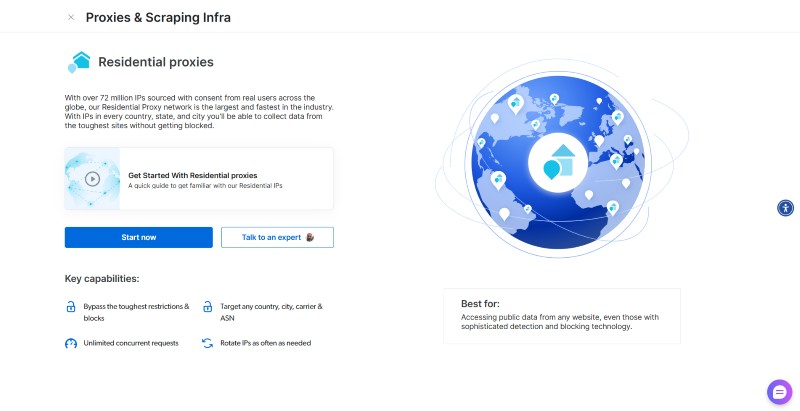
During our test, the residential proxies had excellent speed and reliability. Both static and rotating proxies allowed us to surf the web seamlessly and bypass strict website geo-restrictions. You can manage all proxies from your user dashboard, deploying new ones or removing existing ones at will.
Bright Data gives you significant control over your proxies. You can choose proxies from specific cities, states, and countries. The robust IP network, especially in Europe and North America, makes it easier to bypass geo-restrictions. If an IP address can’t successfully bypass the restriction, Bright Data rotates different IP addresses until it succeeds.
ISP Proxies
ISP proxies are static residential proxies sourced directly from Internet Service Providers (ISPs). Unlike residential IPs that rotate with each browsing session, a static ISP proxy is assigned only to you. You can keep this static IP for as long as your subscription lasts.
Bright Data offers a network of 1,300,000+ fully compliant static IPs spanning 35 countries. The U.S. commands the vast majority of this infrastructure with over 1.17 million static IPs, whereas international locations account for smaller, dedicated pools of fewer than 15,000 each. This smaller number is expected because of the higher costs and difficulty of obtaining IP addresses directly from ISPs.
The static ISP proxies offered excellent speed and reliability during our test. Bright Data lets users manage static IPs directly from their Control Panel or an external API. The user-friendly Control Panel makes it easy to deploy and organize a large number of proxies.
ISP proxies are more reliable than typical residential proxies because they don’t change frequently. Using one IP address for a long period makes it easier to browse anonymously and break through geographical and IP website restrictions. Once you bypass a site’s restriction with a static IP, you can continue accessing the site with that IP. In contrast, rotating proxies mean you can bypass a site’s restriction today and struggle to bypass it tomorrow with a new IP address. Expectedly, Bright Data’s static IPs cost more than rotating IPs.
Datacenter Proxies
Datacenter proxies are sourced from secondary corporations and high-speed server hubs rather than ISPs. A server (in a datacenter) with a unique IP acts as the intermediary between your device and a website you want to access. You can request a shared or dedicated datacenter IP: a dedicated IP is more reliable in circumventing site blockades.
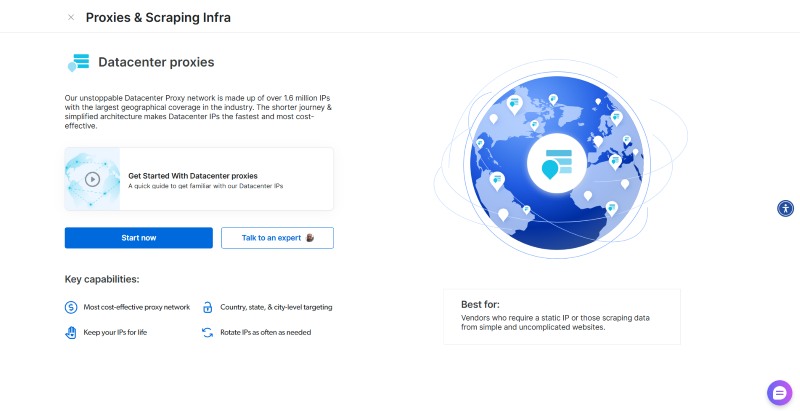
Bright Data offers over 1.6 million datacenter proxies across 98+ countries, unlike residential proxies available in 195 countries. You can select your datacenter proxy by specific country, state, city, or ASN. These proxies are the fastest option in Bright Data's lineup because your browser request is sent directly from the proxy server to the target website, unlike residential proxies that bounce through several peer devices before reaching the target site.
The drawback is that datacenter proxies are more vulnerable to detection and automated bans because of their predictable IP subnet ranges. They are cost-effective but less efficient at bypassing geo-restrictions than residential and ISP proxies.
Web Scraper API
Web scraping is one of the most common use cases for proxy servers. Some businesses need to scrape massive amounts of data from a website, e.g., pricing data from retail sites. However, many websites discourage scraping by implementing geographical and IP restrictions. Proxy IPs let businesses bypass these restrictions and scrape their desired data.
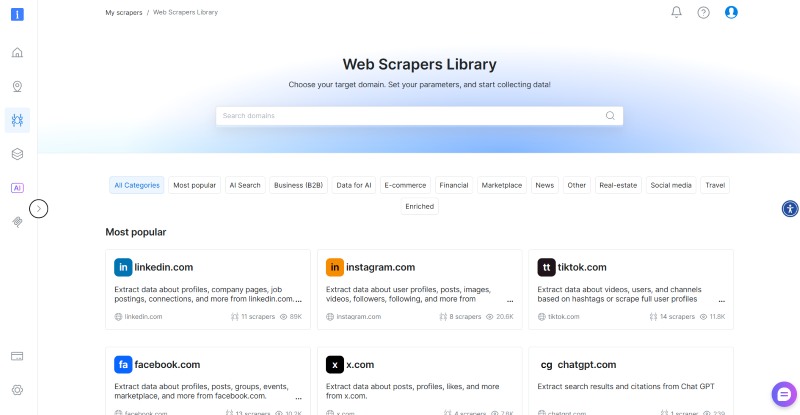
As a first-rate platform, Bright Data doesn’t stop at providing proxy IP addresses for web scraping. It also provides APIs that let businesses automate data scraping without writing complex parsing code or managing proxy pools. It has north of 600 ready-made scraping APIs for websites like Facebook, Amazon, Instagram, LinkedIn, Zillow, X, ChatGPT, YouTube, and TikTok, as well as the AI-powered Scraper Studio for turning any unlisted site into a structured data pipeline. Several websites, such as Facebook, have filed lawsuits to block these scraping APIs, but Bright Data has countersued and prevailed.
Suppose you run a price comparison site that helps people find the best e-commerce deals. You can use Bright Data’s APIs to automate data scraping from Amazon, Walmart, eBay, and other popular e-commerce sites. You’ll then clean the scraped data and display it on your price comparison website.
Bright Data's APIs can handle bulk asynchronous scraping requests, convert raw HTML into structured data, deliver payloads straight to S3/Cloud Storage, and validate data automatically with built-in self-healing parsers.
Datasets
You don’t always have to scrape data from scratch. Bright Data offers an alternative: ready-made datasets sourced from 250+ domains and 700+ structured datasets. It includes the likes of LinkedIn (profiles, company data, job postings), Pinterest, Crunchbase, Amazon, Instagram, Google Maps, and Redfin. You can also get categorical datasets, such as car prices, housing prices, crime rates, NBA players' stats, etc.
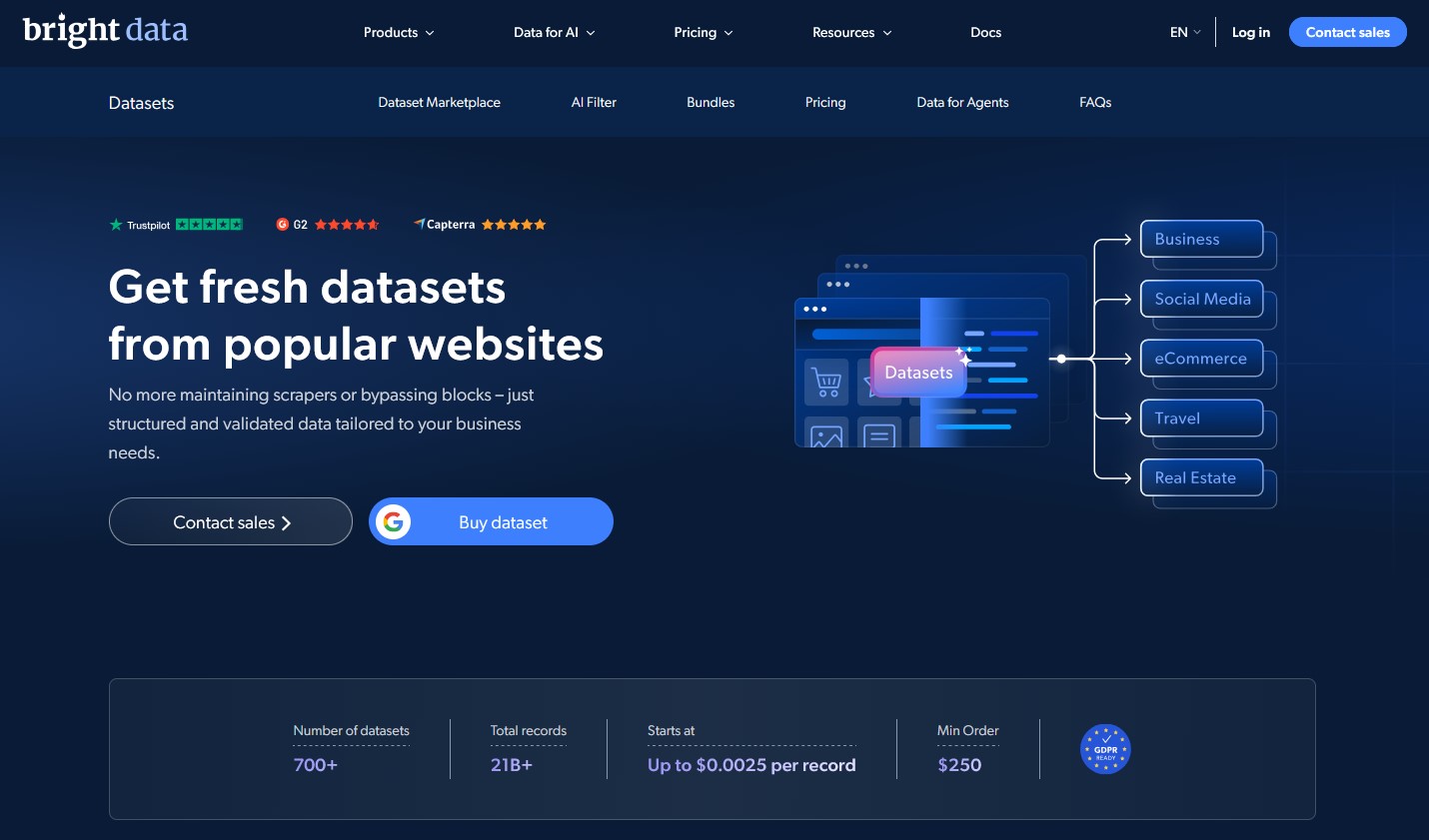
Pre-built datasets reduce headaches for businesses. Instead of scraping data from scratch and waiting a while to access it, you can access over 21 billion clean, validated records. Bright Data even provides an AI prompt tool that lets you describe (in plain English) the precise subset of data you need to filter out fluff before paying.
Ease of Use
Bright Data has an intuitive interface you’ll likely enjoy using. The left menu has all the features you need to access, and the right side is the main dashboard displaying real-time traffic analytics, success rates, bandwidth usage, and so forth. Many features are neatly arranged across the dashboard to make them easy to find. With a white background and a few contrasting colors, Bright Data’s interface looks visually pleasing.
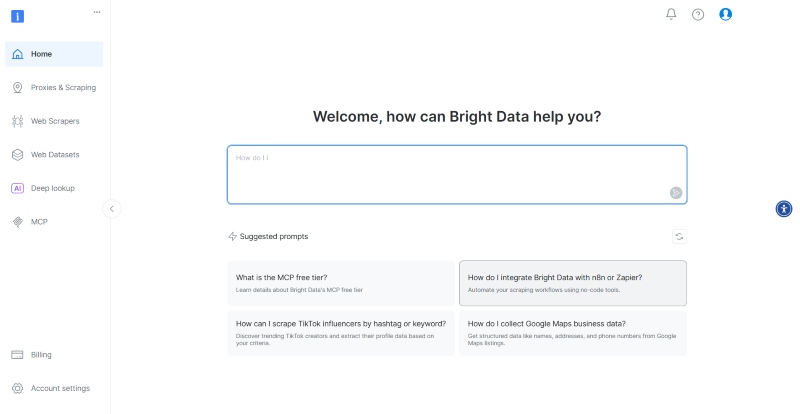
You can access this proxy software primarily from the cloud-based web dashboard. There’s also a Google Chrome and Firefox extension that lets you seamlessly change proxy locations, switch between IP types, and rotate IPs on demand. For complex, large-scale scraping, Bright Data also offers an open-source downloadable Proxy Manager app. The platform’s user-friendliness is unmatched by most rivals, thanks to a fine balance of accessible self-service controls and dev-oriented technical options.
Customer Support
One of Bright Data’s strengths is its top-notch support. You can contact its support team 24/7 and receive a response in less than 30 minutes. It offers support via a dashboard ticketing system, web chat, and email, along with dedicated Slack channels and technical account managers (TAMs) for enterprise accounts, but there’s no telephone support.
Bright Data also provides extensive documentation and user manuals to help users figure out solutions to their problems. The website’s Docs section contains detailed guides for all features and interactive code builders, plus an API reference that helps users write effective data scraping commands.
We found Bright Data’s documentation easy to follow and helpful for our test. For instance, we followed the web scraping tutorial to harvest data from an external website.
The Competition
There’s no shortage of rivals to Bright Data, and the ones we’d like to highlight are Decodo (formerly Smartproxy), Oxylabs, and Webshare.
Decodo is an excellent mid-market proxy provider offering residential, ISP, and datacenter proxies. It's a cost-effective alternative with a large pool of 125 million+ IPs across 195 countries. However, Bright Data has a larger IP pool across the same number of countries and offers more features and customizability.
Oxylabs offers a slightly larger IP pool, with 175 million+ addresses compared to Bright Data’s 400 million+. Both platforms have similar enterprise-grade offerings, but Bright Data provides some features not available in the other, such as a dataset marketplace and browser-based Scraper Studio. Bright Data also has a more responsive support team than Oxylabs, according to our experience when testing both.
Webshare is one of the best alternatives budget-wise that go head-to-head with Bright Data. It’s a notably more affordable tool, including a permanent 10-proxy free tier, which is crucial for small businesses. It offers effective APIs to scrape data en masse, just like Bright Data. However, Webshare has a much smaller pool of IP addresses: roughly 80 million compared to Bright Data’s 400 million.
Final Verdict
Morphing into a full-stack web data platform that goes beyond basic proxy services, Bright Data offers a sizable network of 400 million+ IPs covering 195 countries across residential, datacenter, and static ISP tiers. It pairs its foundational proxy service with an unrivaled suite of data collection and scraping automation tools that include over 600 specialized web scraping and crawling APIs, AI-powered web unlockers, and datasets containing over 21 billion ready-made records.
Thanks to all these features, it’s more than well equipped to provide you with anything you need to bypass website restrictions and scrape required data (developers and AI research teams will particularly be happy with the scope of features). There are a few drawbacks here and there, primarily its higher cost compared to the competition, but it might well be worth it, especially for high-volume needs.
We've also highlighted the best proxy and best VPN


Comments
Post a Comment