KEF's nouveau Muo is a solid little Bluetooth speaker, but the game's changed since 2016 — and it's no longer top of the pile
KEF Muo 2025: Two-minute review
At a glance, the new KEF Muo Bluetooth speaker is pretty much the same as the old one — you remember, the one that launched back in 2016 (hard to believe, but that is 10 whole years ago). Naturally enough though, KEF has brought the specification up to date in an effort to justify that asking price.
So $249 / £249 / AU$449 buys you 40W of Class D power serving a 20mm and 58 x 117mm ‘racetrack’ mid/bass driver. It also buys Bluetooth 5.4 with aptX Adaptive compatibility, 24 hours or so of playback from a single charge, 43Hz - 20kHz frequency response and ability with Auracast and the option to form a stereo pair, plus the facility to make a hard-wired USB-C connection to get content on board that way too.
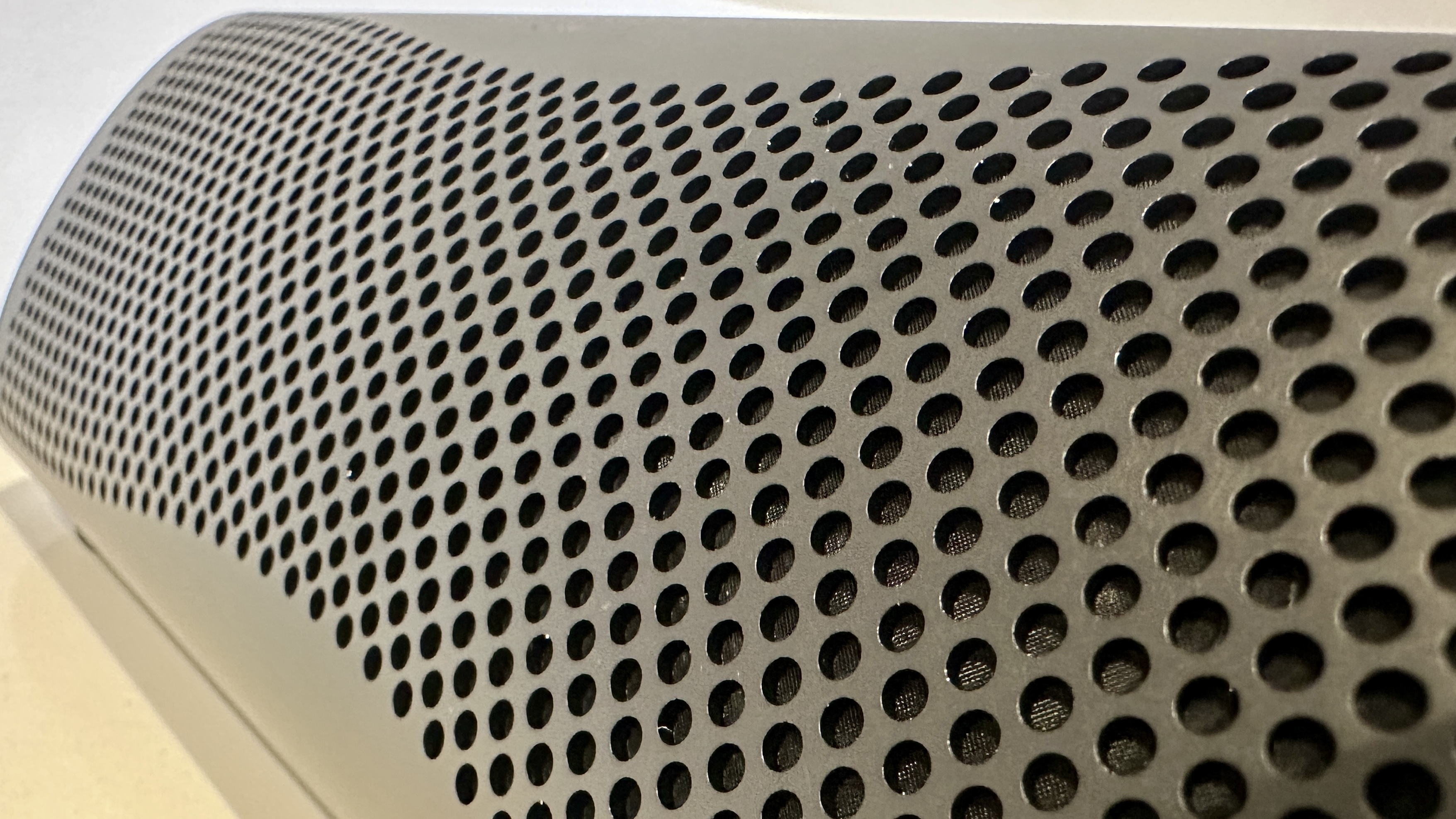
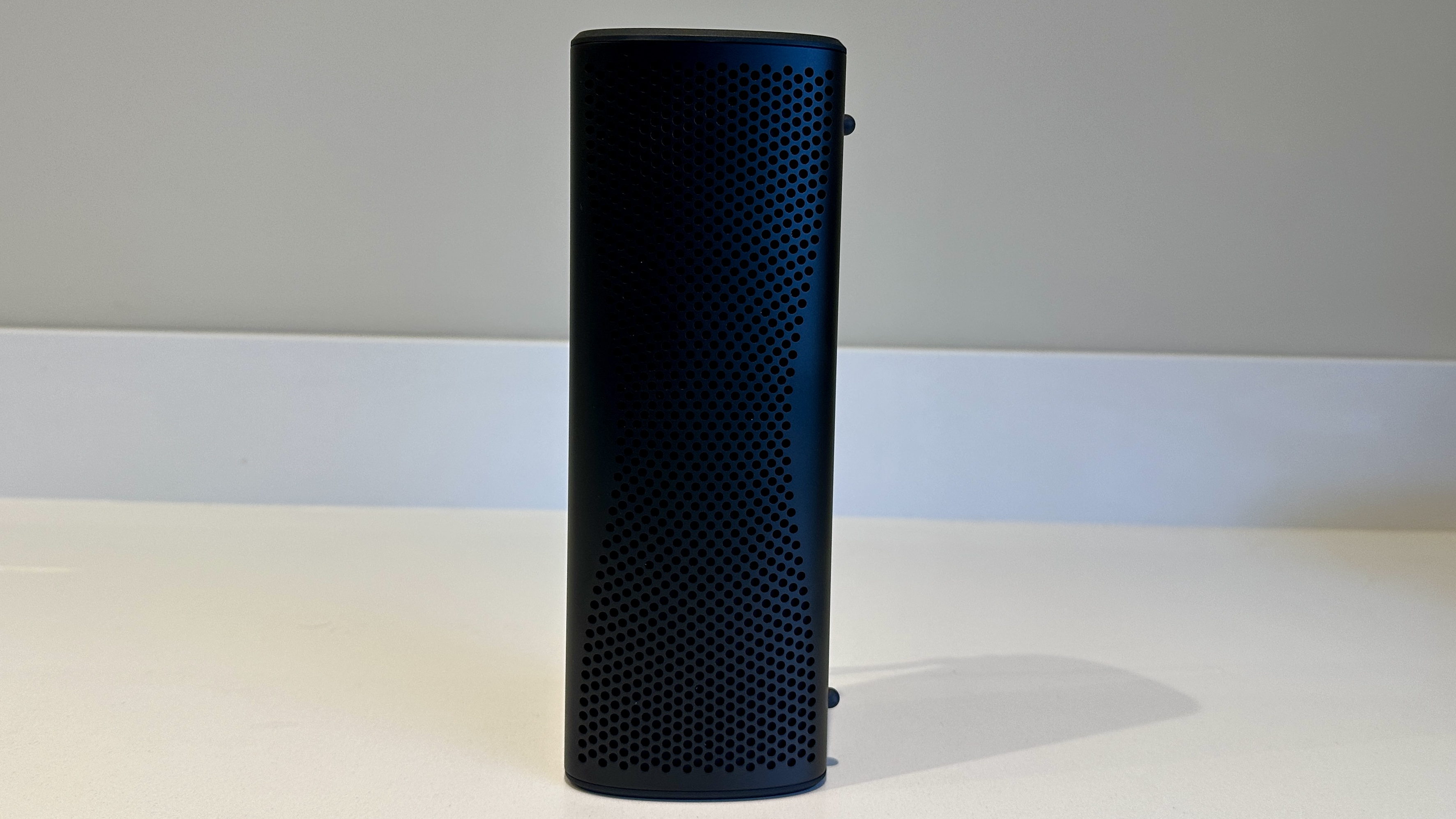
Additionally, it buys some quite svelte good looks available in quite a few different colors, and a high standard of build and finish from a device that’s mostly constructed from aluminium. Portability is guaranteed thanks to a 740g weight and hardiness comes in the shape of an IP67 rating. Just be careful not to dent or scratch that lovely metal finish while you’re out and about…
One of the very best Bluetooth speakers at the price? Well, where performance is concerned, the KEF has a lot more going for it than it has issues — but there’s only so far rhythmic positivity, an expansive and organised soundstage, and great powers of detail retrieval will carry a speaker. The Muo is undermined by its slightly bolshy and over-assertive approach to midrange reproduction, and consequently leaves the door open to a few alternative models that would otherwise be quite firmly shut.
KEF Muo 2025 review: Price and release date
- Released on September 30, 2025
- Officially priced $249 / £249 / AU$449
The KEF Muo is on sale now (having arrived at the very end of September 2025) and in the United Kingdom it sells for £249. It’s available in the United States for $249, while in Australia it goes for AU$449. The market for Bluetooth speakers is enormous, of course - but it seems, given both the asking price, the design aspect and the use of materials, that KEF has Bang & Olufsen's A1 3rd Gen firmly in its sights…
KEF Muo 2025 review: Specs
|
Weight: |
740g |
|
Dimensions: |
216 x 82 x 59mm |
|
Battery life (quoted): |
Up to 24 hours |
|
Connectivity: |
Bluetooth 5.4 with aptX Adaptive |
|
Drivers: |
One 20mm dome tweeter and one 58 x 117mm ‘racetrack’ mid/bass driver |
|
Aux-in: |
No (USB-C audio passthrough) |
|
Charger port: |
USB-C |
|
Microphone: |
Yes |
|
Waterproof rating: |
IP67 |
KEF Muo 2025 review: Features
- Bluetooth 5.4 with aptX Adaptive
- USB-C for charging and for data transfer
- 40W of Class D power
With one or two very rare exceptions, a Bluetooth speaker is a purely functional device and is specified accordingly. The KEF Muo, it’s fair to say, adheres to the rules rather than being an exception to them.
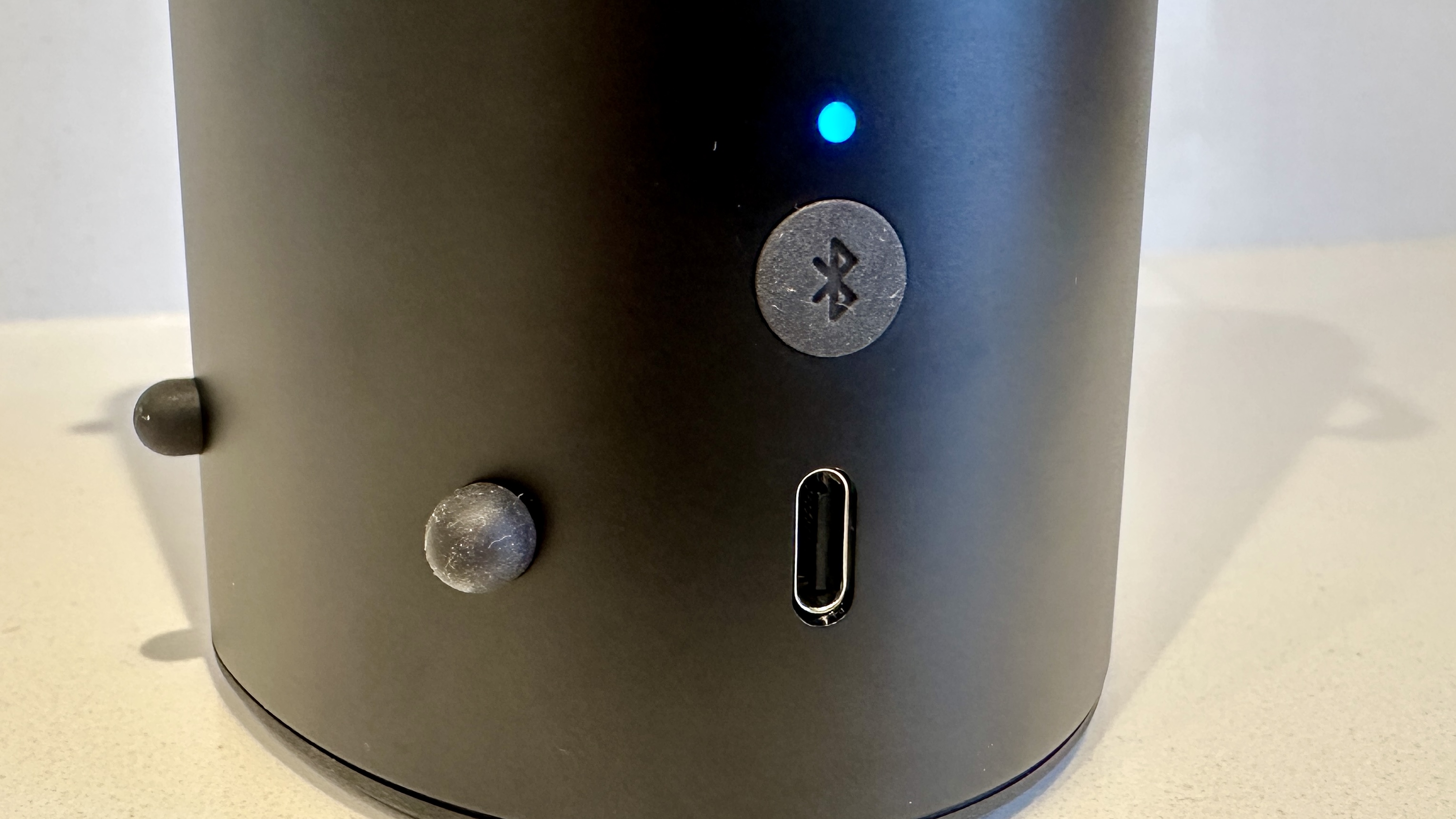
It uses Bluetooth 5.4 for wireless connectivity, and is compatible with the SBC, AAC and aptX Adaptive codecs. The USB-C slot on the rear of the cabinet can be used for data transfer as well as for charging the battery, and if you hard-wire the speaker to a source of music then digital audio files of up to 16bit/48kHz are supported. And there are further connectivity options: the Muo is Auracast-compatible, and if you own a couple of these speakers they can be configured as a stereo pair. Microsoft Swift Pair and Google Fast Pair are both available, too.
The battery itself is good for 24 hours of playback between charges, provided you’re not going to town where volume levels are concerned. And when the time comes, you can score an additional three hours of playback from a 15-minute visit to the mains. To go from ‘flat’ to ‘full’ shouldn’t take longer than two hours.
Once the audio information is on board, it’s served to your ears by a couple of drivers that make use of a total of 40W of Class D power. There’s a 20mm tweeter that takes 10 watts, while the other 30 watts goes to a 117 x 58mm ‘racetrack’ mid/bass driver that uses KEF’s ‘P-Flex’ technology. It’s an arrangement, the company suggests, that’s good for a frequency response of 43Hz - 20kHz.
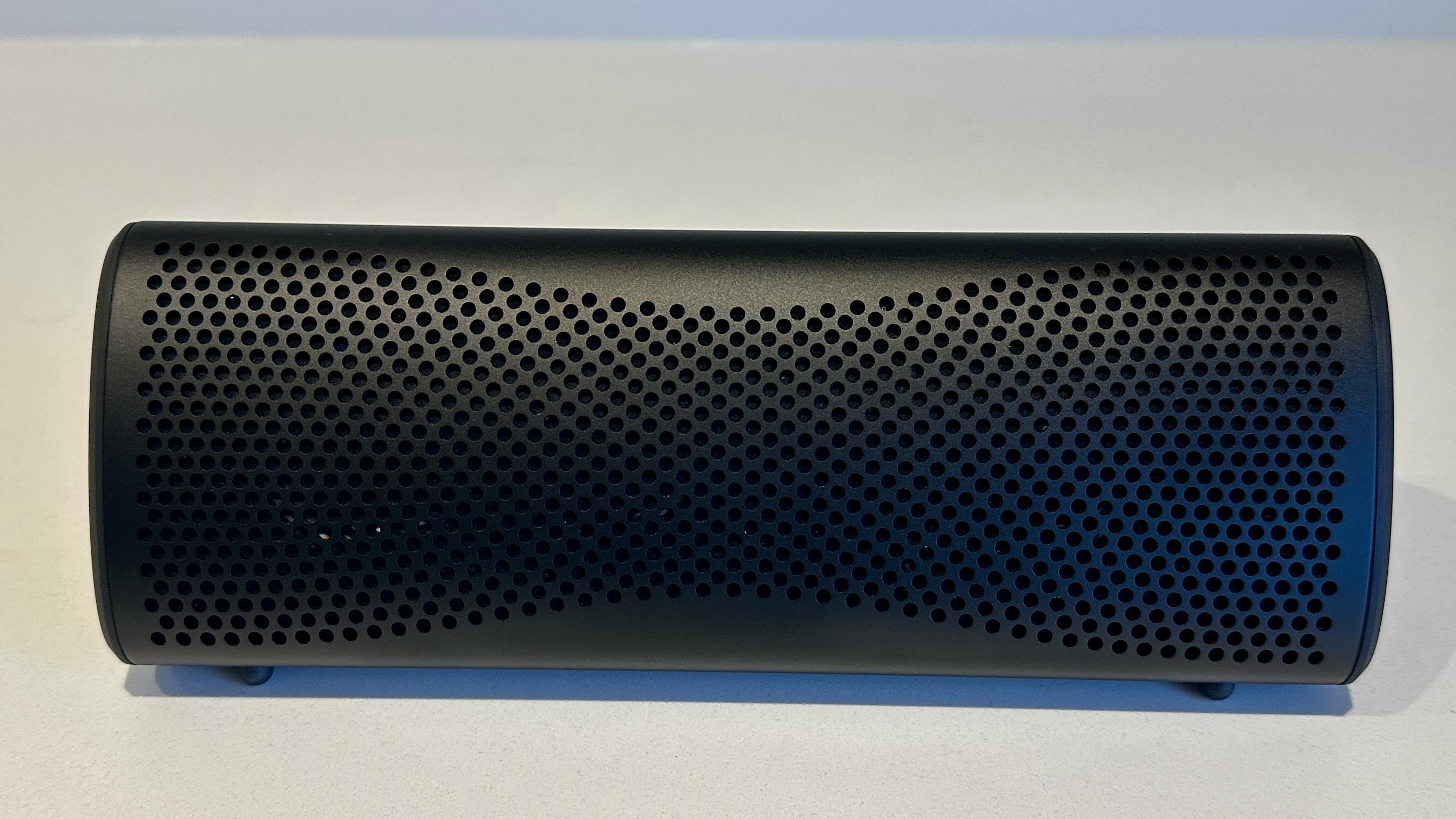
If the speaker is standing upright in a ‘portrait’ orientation, the tweeter is above the mid/bass driver; lie the speaker down on its little rubber feet in a ‘landscape’ style and obviously the drivers are now side by side. The Muo automatically detects its orientation and adjusts its sonic output accordingly.
- Features score: 5 / 5
KEF Muo review: Design
- 216 x 82 x 59mm (HxWxD)
- IP67 rating
- Choice of seven winsome finishes
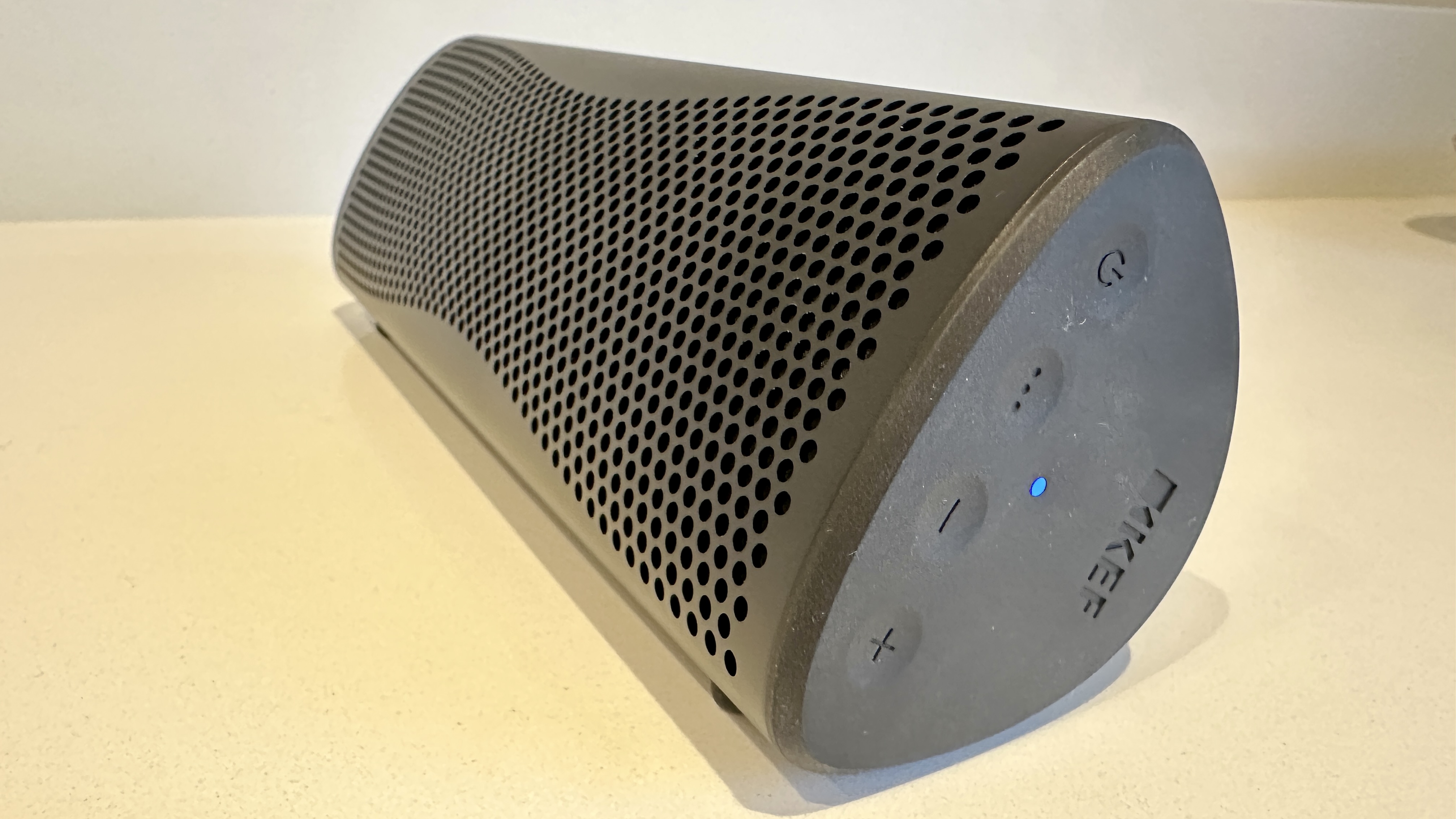
First things first: this is not one of those bouncy, hardy, go-anywhere Bluetooth speaker designs that will emerge unscathed from a careless journey in the depths of a backpack. Oh, there’s absolutely no arguing with the way the Muo is constructed or finished — and IP67 rating against dust and moisture lets you know it’s tough enough — but the majority of the chassis is made of aluminium and it’s far from difficult to imagine marking or even denting the finish if you’re careless.
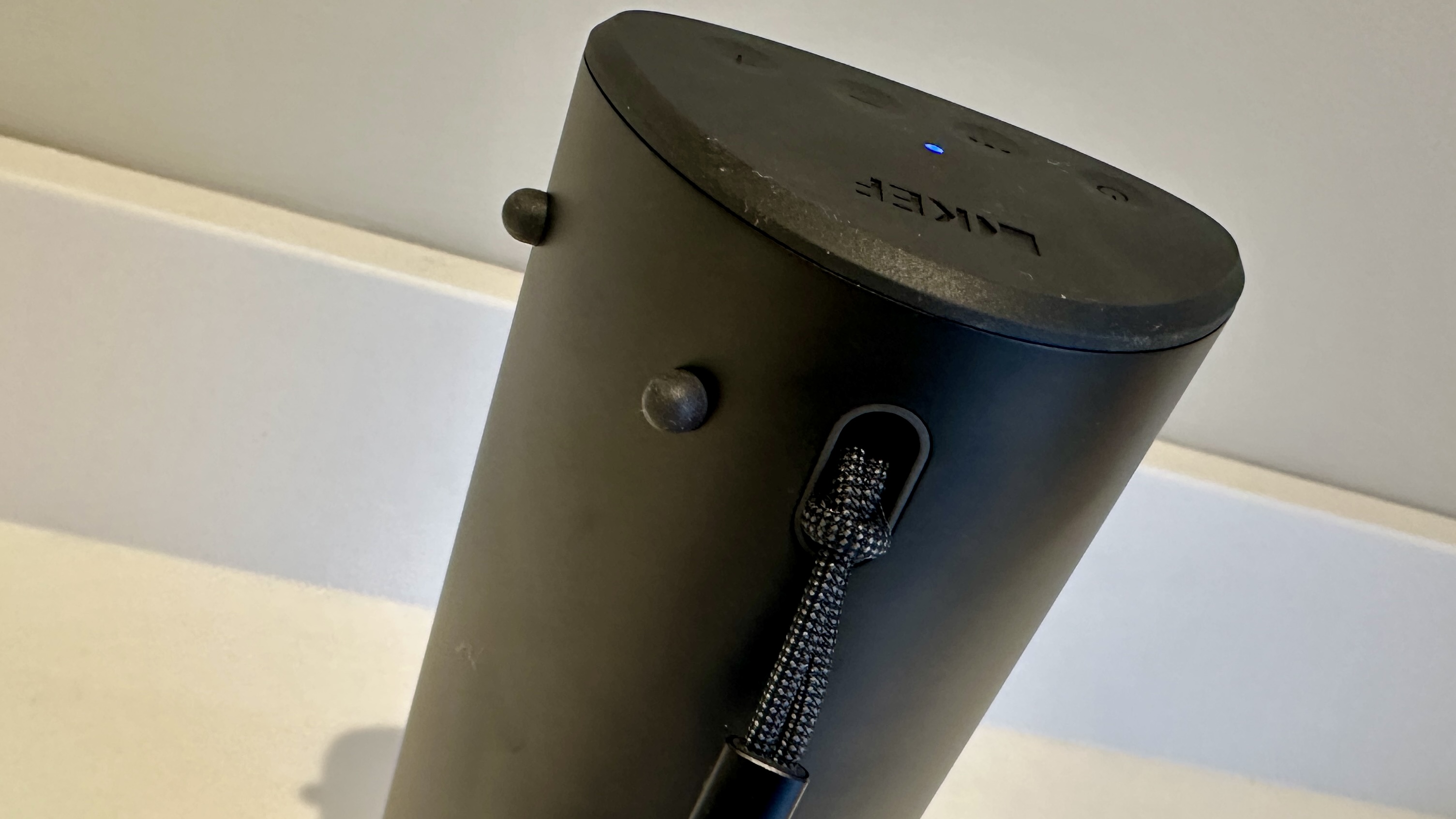
So while the 740g weight, 216 x 82 x 59mm (HxWxD) dimensions, integrated carry-strap and rubberised end-caps mean it’s fully portable, it’s important to have a degree of respect for the design choices here if you’re taking it out and about.
My review sample arrived in the ‘midnight’ black finish, and while there’s absolutely nothing wrong with it in isolation — in fact, to my eyes it looks quite discreet and sophisticated — there’s no getting away from the fact that the other half-a-dozen finishes are a bit more interesting. No matter if you select silver ‘dusk’, ‘moss’ green, blue ‘aura’, ‘cocoa’ brown or orange ‘moon’, you’ll be in possession of a speaker that looks and feels like the premium item it’s priced as.
- Design score: 5 / 5
KEF Muo 2025 review: Sound quality
- Great control and variation at the bottom of the frequency range
- Impressive scale from a relatively compact cabinet
- Midrange reproduction is not the last word in subtlety
In some ways — in many ways, in fact — the KEF Muo is a match for the best $250-ish Bluetooth speakers out there. It has plenty of positives where the sound it makes is concerned, but it’s equally true to say that it comes up short where some disciplines are concerned.
Listen to a 1bit/2.8MHz DSF file of Steely Dan’s Peg delivered via Bluetooth and there’s plenty to enjoy. The Muo is a notably expansive listen, able to easily escape the confines of its fairly little cabinet and create a genuine sense of scale in the recording. It does great work at the bottom of the frequency range — that claim for response down to 43Hz might seem optimistic but there’s no getting away from the fact the KEF digs deep and hits hard.
It exhibits great control and variation at the low end, too. Some speakers just thump along, but the Muo has some light and shade to its bass, and a degree of insight into texture and timbre that’s by no means a given. The straight edges at the attack of low-frequency sounds it creates allow for confident and positive rhythmic expression, too.
The top of the frequency range is equally detailed, and while it’s not the last word in treble substance this speaker stops well short of hardness or high-end edginess — and that’s true even if you decide to explore the upper limits of the levels the KEF is capable of. There’s a fair amount of scope where dynamics are concerned, and the Muo is able to switch from ‘quiet’ to ‘loud’ without any apparent stress and without altering its sonic character in any meaningful way.
Frequency response is nice and even, and the transition from the very bottom of the frequency range to the very top is smooth. Problems, such as they are, concern the way the KEF reproduces the midrange. The midrange is distinct from everything happening above and below it. In particular, it’s distinct where tonality is concerned — where the lower and upper frequencies are quite neutral and natural, there’s a forcefulness and a hint of glassiness that’s bordering on stridency to the way the speaker delivers midrange information.
Despite being just as detailed here as in every other part of the frequency range, the KEF hits the midrange hard and, especially when it comes to dealing with voices, is not beyond becoming a little ‘shouty’. No matter if it’s the otherwise-smooth sounds of Steely Dan or a 16bit/44.1kHz file of Doechii’s Alligator Bites Never Heal, voices are approaching relentless and don’t require much encouragement, volume-wise, to occupy the front of the soundstage.
Ultimately there’s not as much subtlety to the way the KEF handles the midrange as is ideal. The fact that it’s so deft and nuanced in every other respect only throws this trait into sharper relief.
- Sound quality: 4 / 5
KEF Muo 2025 review: Usability and setup
- KEF Connect control app
- Some physical controls
- Speakerphone ability
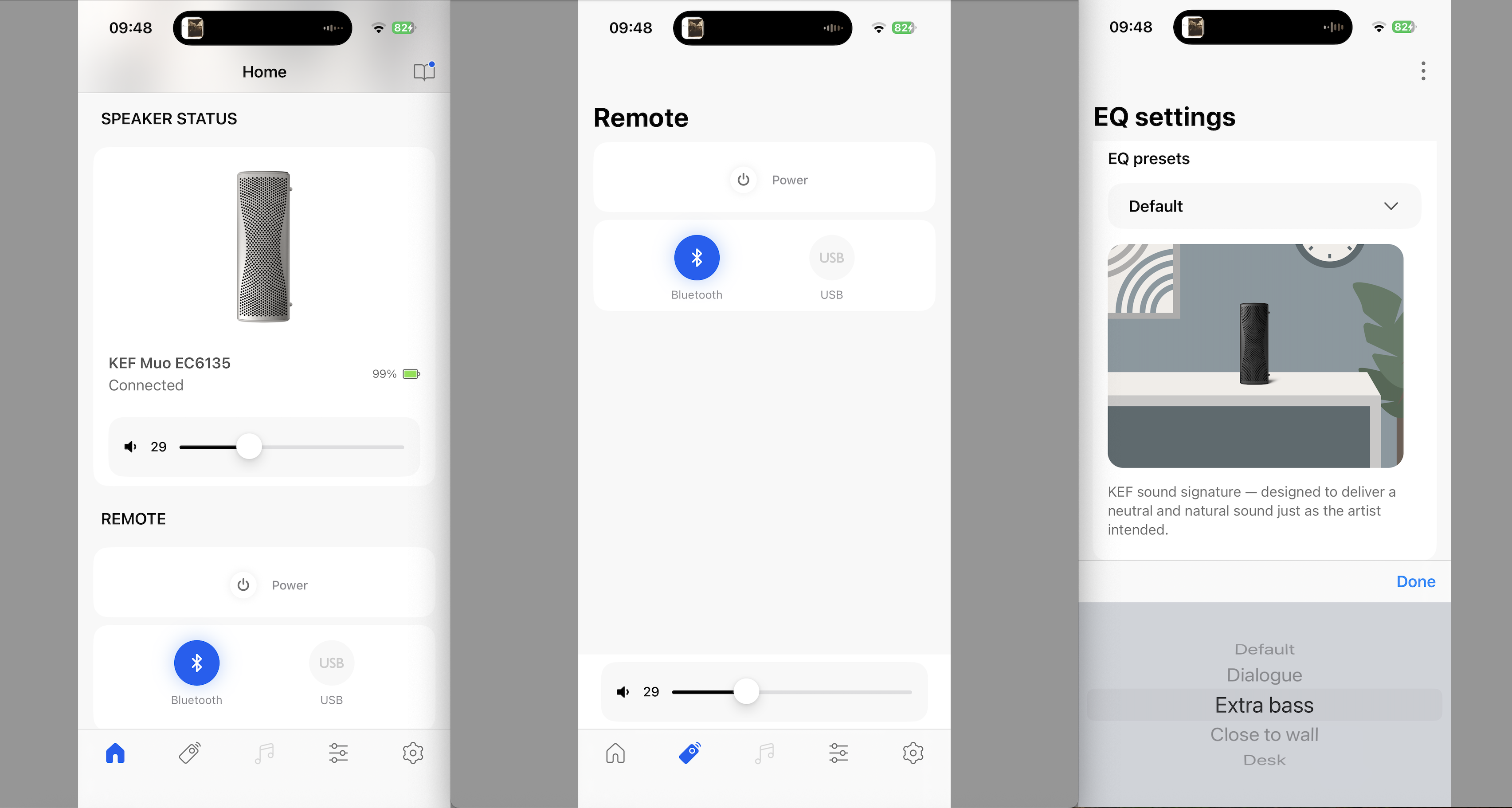
Controlling the Muo can be done in a couple of ways. You can use an extremely brief version of the KEF Connect control app that allows control of volume and input selection, as well as giving access to five EQ presets and an indication of battery life.
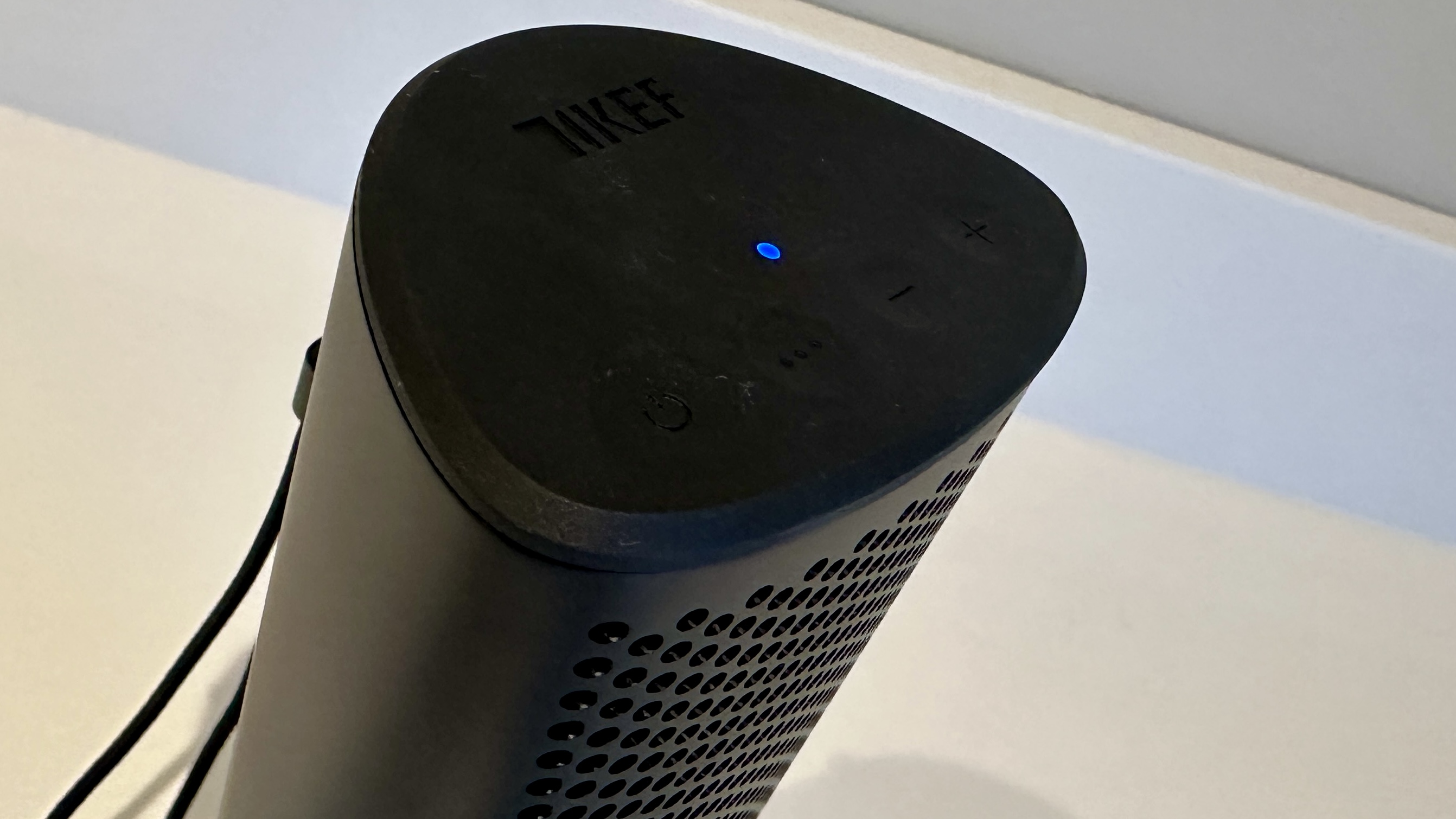
And there are physical controls that run to a button to initiate Bluetooth pairing (on the rear of the frame), and buttons on the top covering ‘power on/off’ and ‘volume up down’.
There’s also a ‘multifunction’ button here that can handle ‘play/pause’ and ‘skip forwards/backwards’ and ‘answer/end/reject call’. Using the Muo as a speakerphone is simple (and becoming a rarity), and the built-in mic features noise- and echo-cancellation technology.
The day a Bluetooth speaker is difficult to set up and operate will be a sad one — and thankfully the Muo is as straightforward as you would hope. Open the ‘Bluetooth’ settings page of your source player, and press the ‘Bluetooth pairing’ button on the speaker — connection is swift and stable, and the next time you power the Muo on it will automatically seek to pair with its most recent partner.
- Usability and setup: 5 / 5
KEF Muo 2025 review: Value
The KEF Muo looks and feels like a premium speaker, and in this respect it goes quite some distance towards justifying the asking price. There’s no arguing with the standard of its construction or finish, and its IP67 rating lets you know it’s ready to survive and thrive in any realistic environment.
And where sound is concerned, it’s most of the way there — but where it comes up short, it’s so noticeably lacking that it undermines the whole ‘value for money’ proposition more than somewhat.
- Value score: 4 / 5
Should I buy the KEF Muo 2025?
|
Attributes |
Notes |
Rating |
|---|---|---|
|
Features |
A Bluetooth 5.4 speaker with aptX Adaptive, USB-C data transfer and even speakerphone duties — lovely |
5/5 |
|
Design |
Comes in seven finishes, just don't throw its aluminum casework around too much |
5/5 |
|
Sound quality |
Mostly deft and nuanced but let down by a harsh and rather shouty midrange |
4/5 |
|
Usability and setup |
The app is functional, and setup is aided by perks such as Google Fast Pair |
5/5 |
|
Value |
The build quality is worthy of the price tag; the sound quality is just a shade off |
5/5 |
Buy it if…
Look and feel is as important as sound
No two ways about it, the Muo presents like a premium item
You want to choose from a wide range of finishes
How does a choice of seven sound?
You’re interested in wider connectivity
The Muo can be one half of a stereo pair, or part of an Auracast set-upView Deal
Don’t buy it if…
You judge strictly on a sound-per-pound basis
The way the Muo treats the midrange of a recording is rather at odds with the work it does everywhere else
You’re a bit careless
The IP67 rating is one thing, the vulnerable nature of all that aluminium is quite another
KEF Muo 2025 review: Also consider
As I said at the top of this review, it seems pretty obvious to me that KEF has the A1 3rd Gen from Bang & Olufsen firmly in its sights with the Muo. They are both quite self-consciously upmarket propositions, both make liberal use of tactile aluminium, and both are designed to please the eyes almost as much as the ears. And in some ways, the KEF is perfectly capable of holding its own in the company of the B&O — but when it comes to the way each speaker handles the midrange, it ceases to be quite so much of a contest.
How I tested the KEF Muo 2025
I used the Muo on my desk, in the kitchen, and in the garden (for the brief moments when it wasn’t blowing a gale). I connected it wirelessly to an Apple iPhone 14 Pro and a FiiO M15S (the latter of which allows connectivity via the aptX codec). I also hard-wired it to an Apple MacBook Pro (loaded with Colibro software) using the USB-C socket.
- First reviewed: April 2026


Comments
Post a Comment