I reviewed the Eversolo DAC-Z10, and this DAC/preamp/headphone amp combo reveals details you didn't know were in your music
Eversolo DAC-Z10: one-minute review
Never let it be said that Eversolo is not ever so serious. The Eversolo DAC-Z10 is an extremely well-specified digital-to-analogue converter, headphone amplifier and system preamplifier in a single package – and while it sells for a significant sum, even compared to the best DACs around, it turns out to represent unarguable value for money.
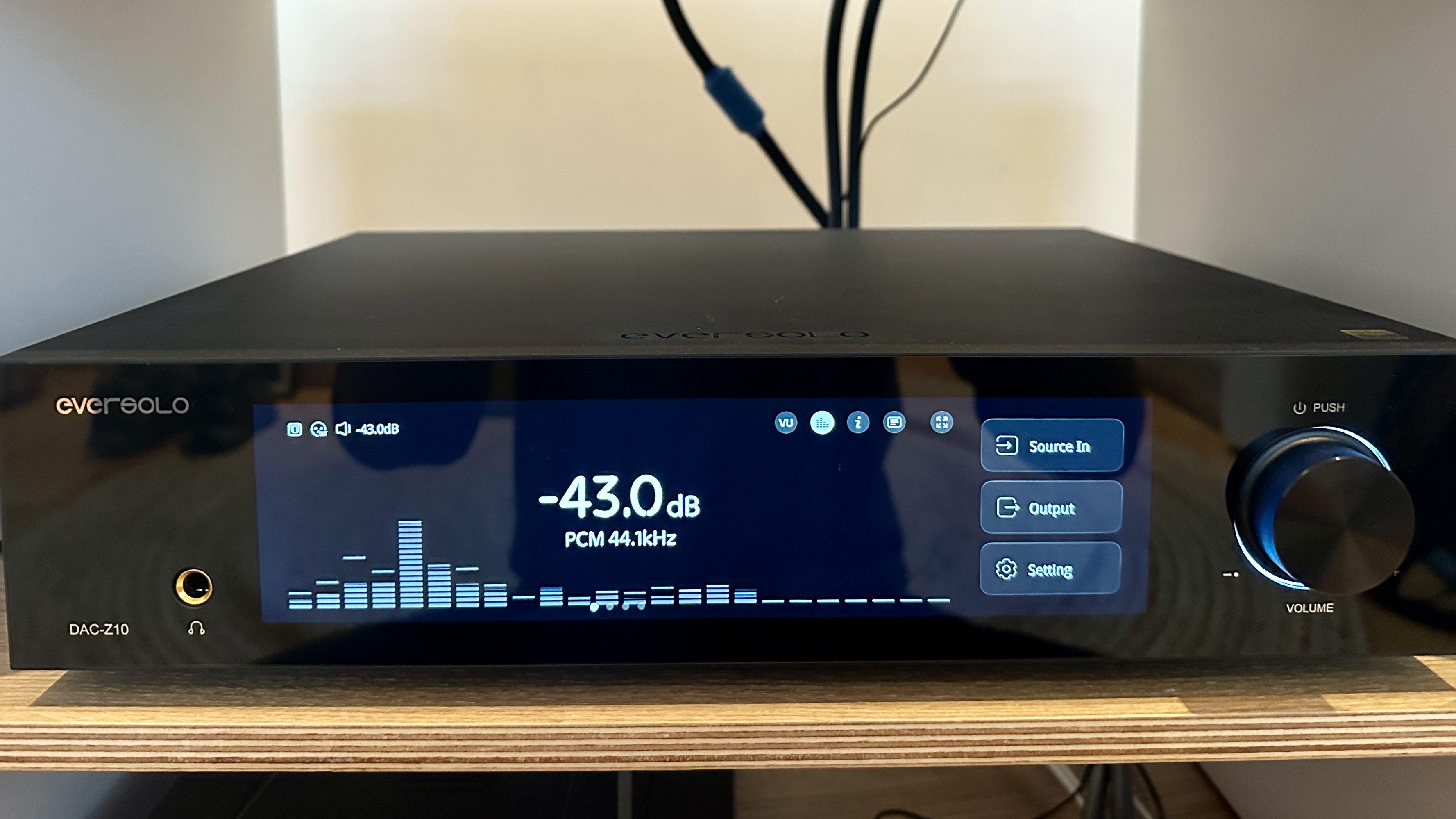
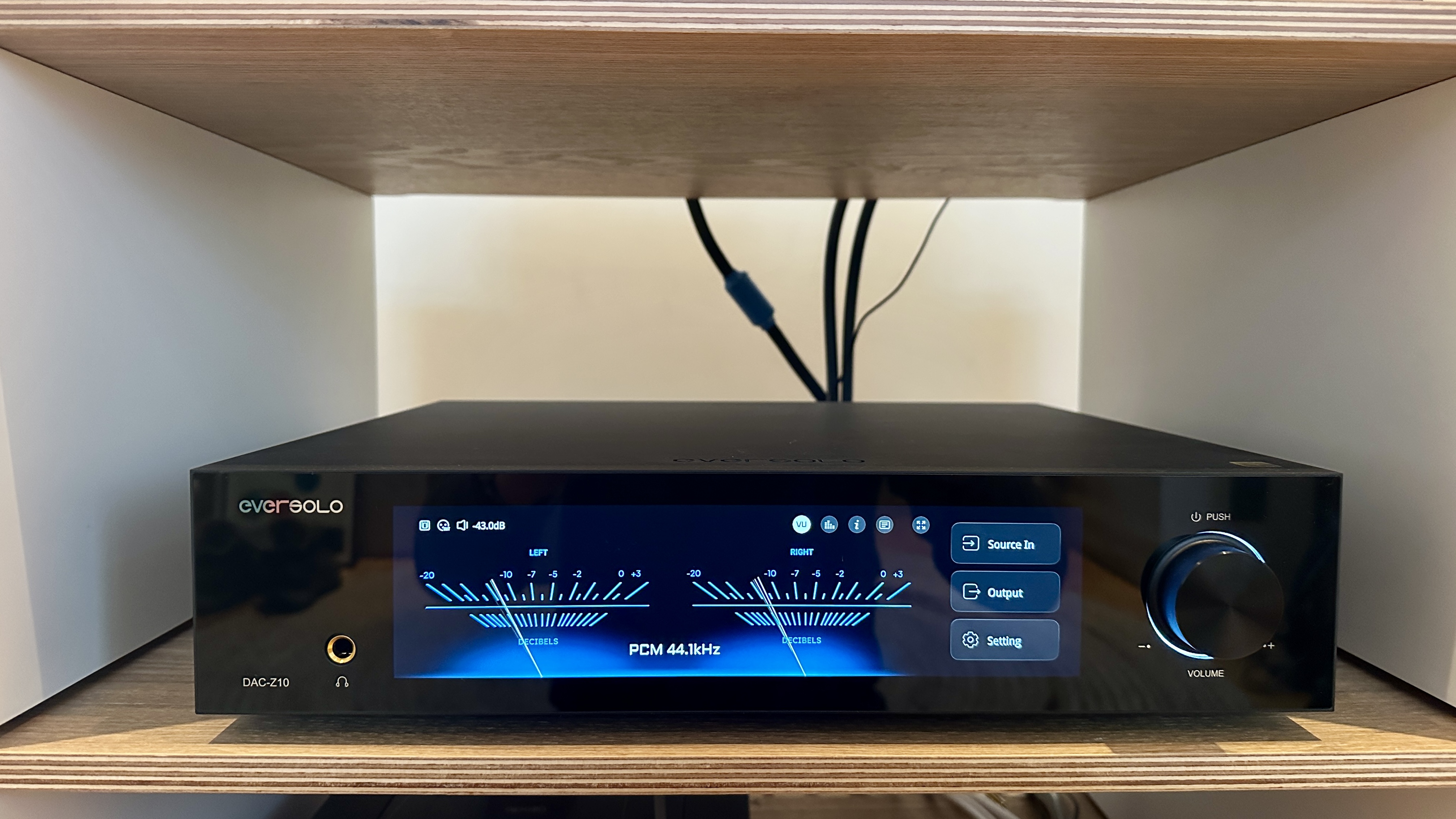
As well as the full-on specification (which includes four AKM DAC chips, twin RSR ‘ladder’ volume control modules, and no fewer than three independent and heavily shielded linear power supplies), the user interface (via a big touch-screen) is excellent even before you realize it offers a choice of virtual VU meters and dynamic spectrum displays.
There are more than enough digital inputs, plus balanced and unbalanced analog outputs, and an extremely capable discrete headphone amplification module.
And it all works very well indeed. The DAC-Z10 is almost fanatical when it comes to detail retrieval, really holds its own where rhythmic expression, soundstaging and dynamic impetus are concerned, and maintains the tonal balance of the music as originally recorded as much as possible.
In fact, about its biggest shortcoming is how overtly intolerant it is of inferior partners – don’t imagine the DAC-Z10 is about to make a silk purse out of the sow’s ear that is sub-par electronics or loudspeakers. But that's not a real flaw for something that costs this much anyway – you'd expect an expensive DAC to sing with expensive other components, wouldn't you?
Eversolo DAC-Z10 review: Price & release date
The Eversolo DAC-Z10 launched during November 2025 and in the United Kingdom it sells for a strangely specific £1,939. In the United States it’s $1,980, while in Australia the going rate is AU$3,339 or thereabouts.
This puts it in line with options from the likes of Denon and NAD – big names in the hi-fi separates space.
Eversolo DAC-Z10 review: Features
- Numerous digital and analog inputs
- Independent left and right channel AKM digital-to-analog conversion modules
- Three independent power supplies
Even by Eversolo’s established standards, the DAC-Z10 is extensively specified – ‘lavishly’ may not be too strong a word. It’s difficult to know where to start, really. Maybe on the outside would be best…
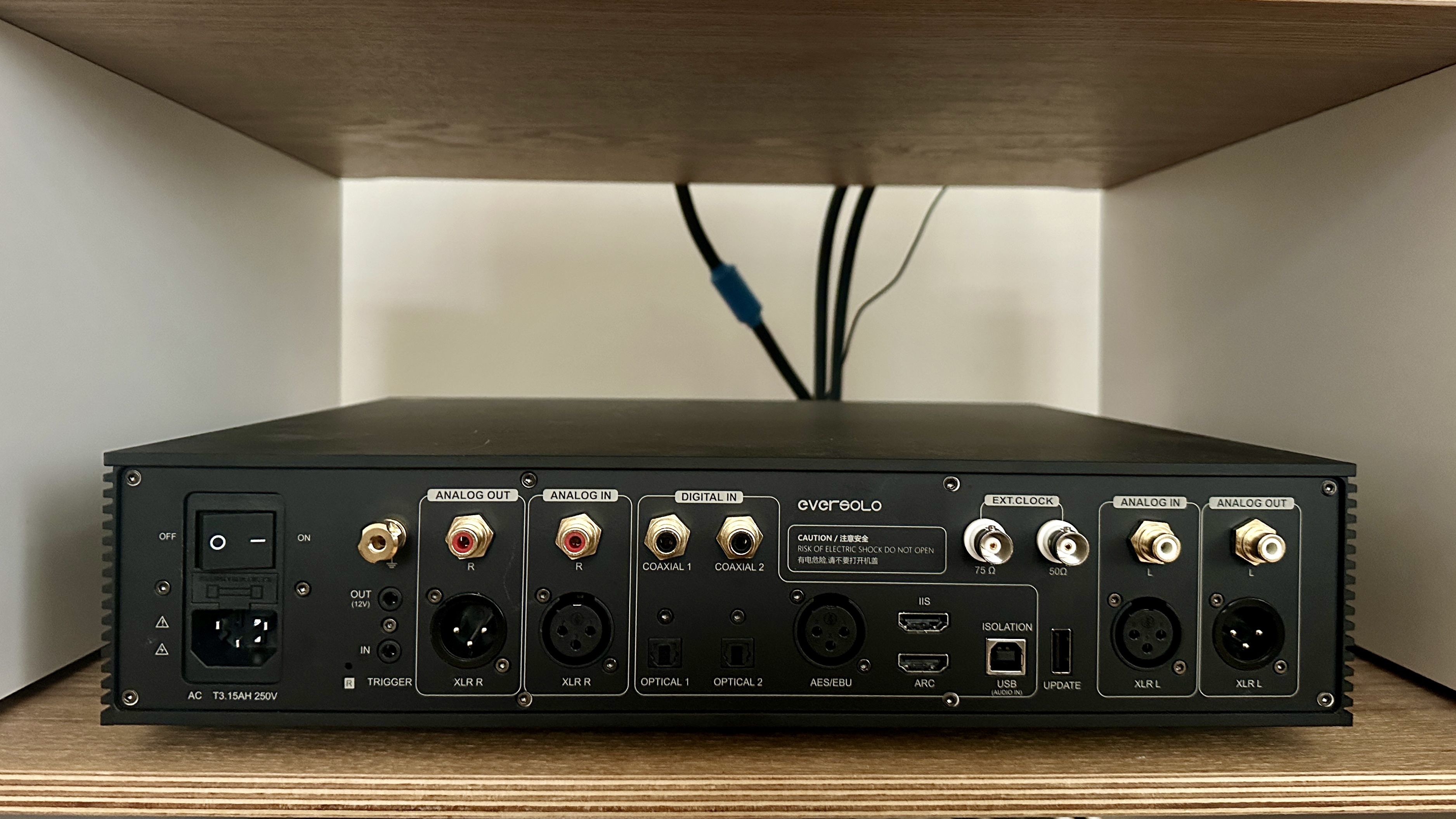
At the rear of the DAC-Z10, there are numerous digital and analogue inputs, alongside balanced XLR and unbalanced RCA analogue outputs for connection to a power amplifier, powered speakers or what-have-you. There’s also a grounding post for channeling even the most minor electrical interference out of harm’s way.
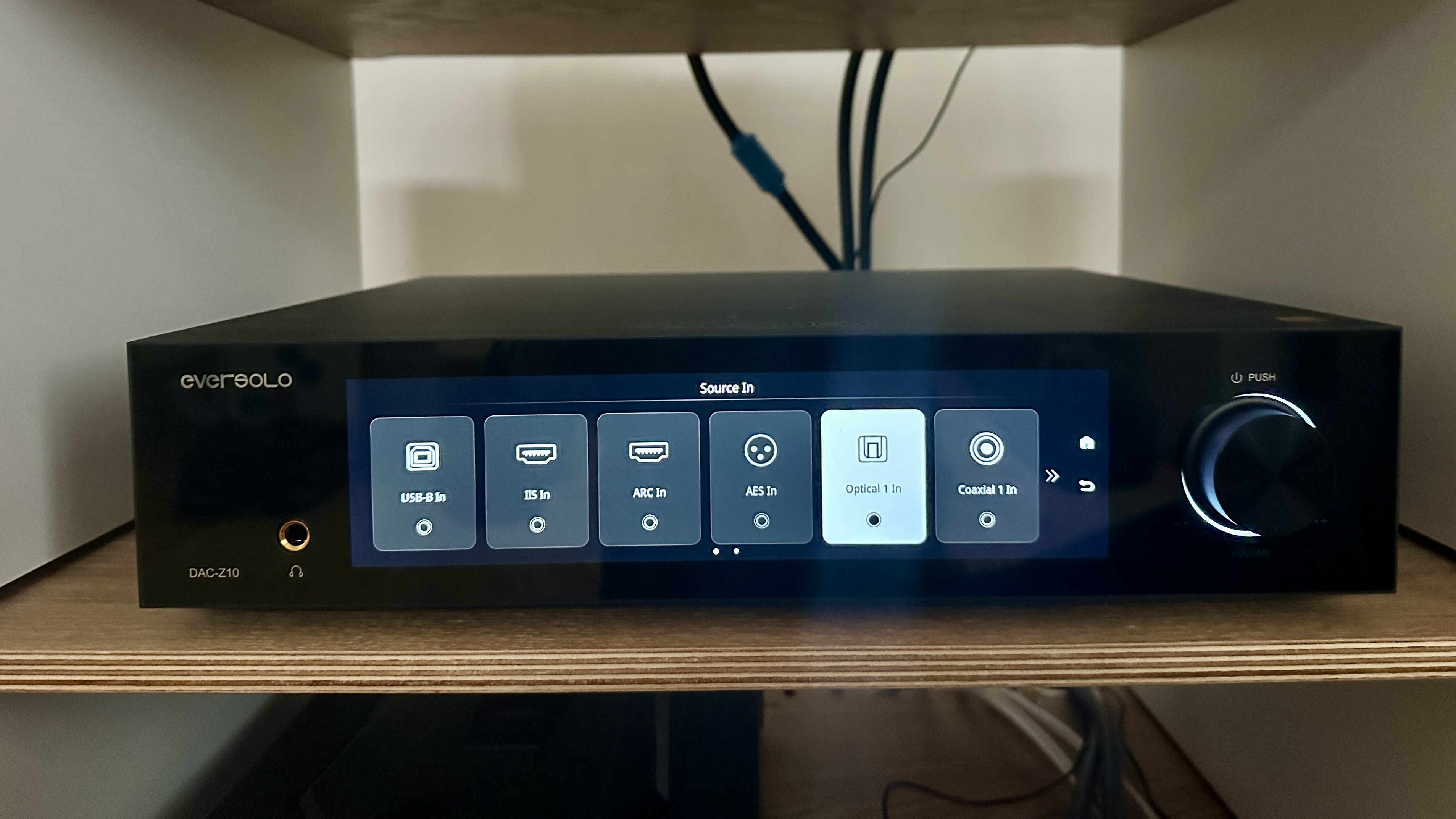
The digital stuff consists of an IIS (aka I2S) input (featuring eight switchable modes, naturally, and capable of dealing with digital audio resolutions of up to 32bit/768kHz PCM and DSD512), HDMI eARC, USB-B (with multi-core audio processor and again supporting 32bit/768kHz PCM and DSD512), a fully isolated AES/EBU input, and a pair of coaxial and a pair of optical audio inputs (all of which support 24bit/192kHz PCM and DSD64). There’s also wireless connectivity via Bluetooth 5.0, with SBC and AAC codec compatibility.
There’s a further analog output on the fascia: a 6.3mm single-ended headphone socket. It’s powered by a dedicated amplification module, and automatically detects the impedance of the headphones it’s driving and adjusts gain accordingly.
The internal layout of the Eversolo is no less thorough. Built on the company’s ‘Fully Isolated Architecture’ platform, which isolates the digital and analog domains in a drive for optimal signal purity, the DAC-Z10 features three linear power supplies. One is for the left channel, one for the right, and one for system circuitry – each is isolated from the others in an effort to minimi`e interference.
The DAC-Z10 is big on the concept of independent left and right stereo channels elsewhere, too. For instance, each stereo channel has a dedicated pair of AKM DAC chips – an AK4191 and an AK4499 – so left and right digital signals are kept completely separate from input to conversion.
Volume control uses an independent R2R ‘ladder’ module for each channel, so signal integrity and phase alignment should be uncorrupted, even if the selected volume level is very low or very high.
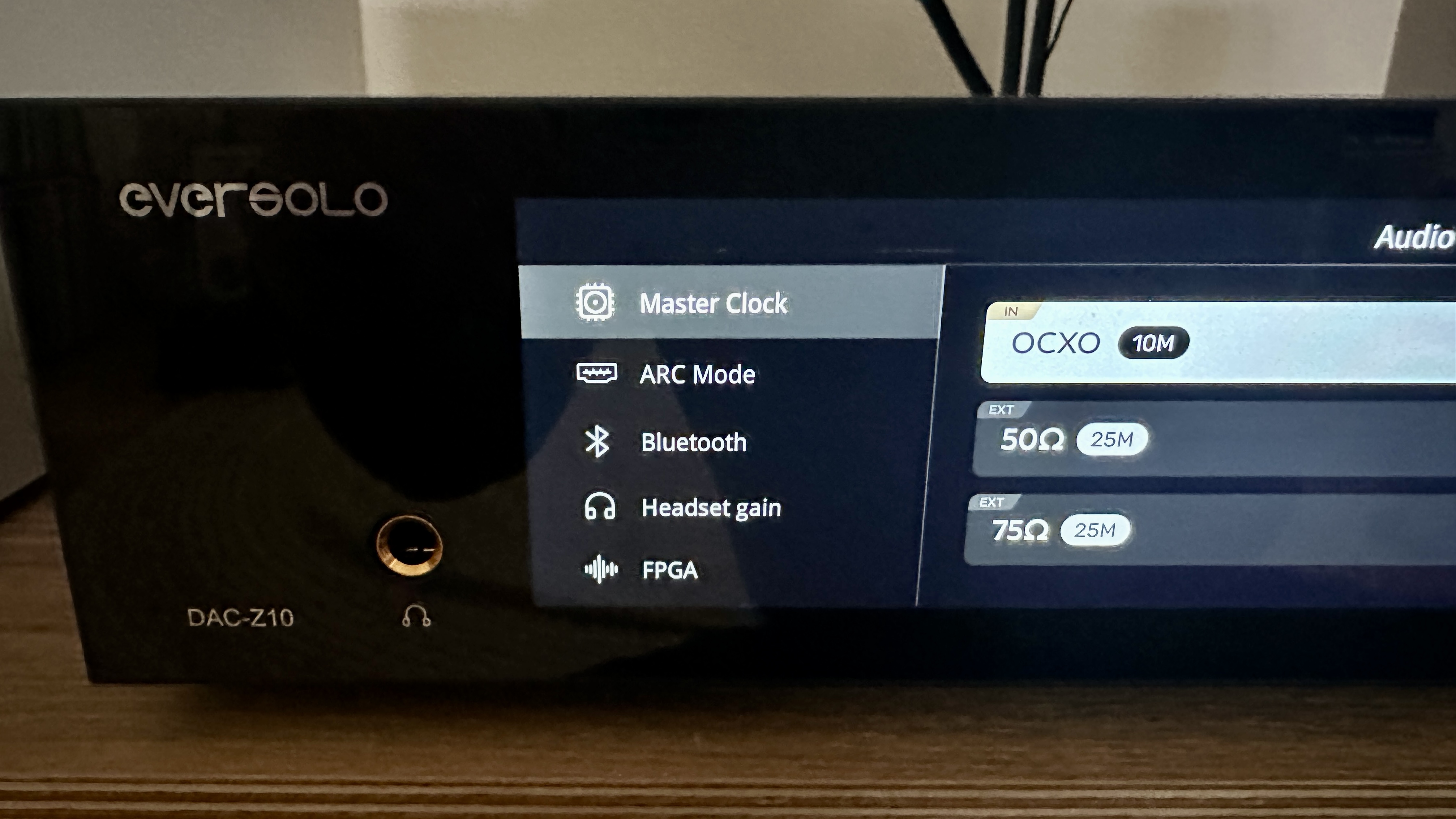
The Eversolo ‘Precision Core’, which features a temperature-controlled crystal oscillator, phase-locked loop technology and FPGA clock reconstruction, makes up the DAC-Z10 clock system. Despite the extremely thorough attention it has paid to this critical componentry, though, the Eversolo also has an input for an external clock – and with multiple impedance options.
This allows the DAC-Z10 to integrate into super-high end systems that have even more effective clock systems than the one specified here. Either way, though, the DAC-Z10 seems extremely well-served where clocking, and by extension the imaging and transient response of its sound, are concerned.
- Features score: 5 / 5
Eversolo DAC-Z10 review: Sound quality
- Profoundly impressive detail retrieval
- Expansive, organized and front-foot sound
- Not especially tolerant of less-capable partners
Let’s get the minor negative out of the way first, shall we? The Eversolo DAC-Z10 is not about to indulge in partnering equipment that is less capable than it is. The DAC-Z10 punches above its weight, not below it – so it can hold its own in systems with high price-tags, but it’s not about to make your run-of-the-mill power speakers or wallet-friendly amps into world-beaters. If anything, it’s more likely to expose their shortcomings.
But as long as the stuff before and after the Eversolo in the chain is up to scratch, there’s a whole lot to enjoy about this device – especially where its powers of digital-to-analog conversion are concerned.
Where detail retrieval is concerned, the DAC-Z10 is as good as anything I've heard at anything like the price. No event in a recording is too minor, no harmonic variation is too subtle, no over- or undertone surrounding the fundamental note of an instrument or a voice is too muted to elude it.
The production of Horsegirl’s Phonetics On and On is open and so spare that you might think every shred of information is available even when it’s playing on an unremarkable system – but the Eversolo demonstrates that even deeper subtleties and transients are there, and it has the power to reveal and contextualize them. If you’re after the most complete image possible of your music, the DAC-Z10 is ready and able to give it to you.
It’s more than willing to get out of the way of the music, and of the source machine that’s playing it. So when it comes to tonality and frequency response, the Eversolo tries its utmost to have as little input as possible even though it’s responsible for D-to-A conversion – the sound you get, in these respects, seems very much to be the sound stored on the disc, the digital file or whatever.
What the DAC-Z10 will do is ensure that low frequencies are shaped and controlled to the point that rhythmic expression is coherent and momentum levels never dip below what is appropriate.
It takes care of the minor dynamic variations with just as much ease as it does with every other aspect of detail retrieval – and when the music undergoes big shifts in intensity or volume, as it does during a listen to Daniel Blumberg’s soundtrack to The Brutalist, the Eversolo is able to describe them in full, and in the most articulate manner.
It ensures the top of the frequency range always carries enough substance to prevent its bite becoming problematic, and allows the midrange to project with real confidence.
And the bigger and more information-packed the audio content you serve it, the more impressive the DAC-Z10 sounds. A DSD64 file of Michael Jackon’s Off the Wall sounds positively ferocious once the Eversolo has done with it – the clean, open and pristine recording (especially in 2024 remaster guise) sounds more animated, more immediate, and more engaging than it does via any even vaguely price-comparable alternative. And there are plenty of very capable, vaguely price-comparable, alternatives around.
- Sound quality score: 5 / 5
Eversolo DAC-Z10 review: Design
- Aluminum chassis
- A choice of VU meters, spectrum displays and control dial colors
- 310x88x365mm / 12.2x3.5x13.4in (WxHxD)
As is only to be expected, given the asking price, the Eversolo DAC-Z10 is carefully constructed from premium materials, and finished to an extremely high standard. Fundamentally it’s simply a rectangular box in the established ‘hi-fi’ manner – but in terms of look, feel and finish it’s a fairly upmarket proposition.
It’s not quite as wide as your average hi-fi separate, but nevertheless Eversolo has found space for an 8.8-inch touchscreen that’s bright, clear and responsive, and is able to display a great deal of information without looking in any way crowded.
It forms the majority of the fascia of a chassis built from aircraft-grade aluminum and coated in a soft(ish)-touch finish that only adds to the impression of refined good taste.
Eversolo has remembered to make sure the design of the DAC-Z10 is enjoyable as well as admirable, too. As well as an exhaustive amount of relevant information, the screen can display a number of different VU meters or dynamic spectrum displays – and the single ‘turn/push’ control dial alongside it can be illuminated in one of quite a few different colors.
- Design score: 5 / 5
Eversolo DAC-Z10 review: Usability & setup
- Remote control, app and touchscreen control options
- Some end-user tweaking available
- Switchable XLR polarity
Despite its wealth of features and extensive functionality, setting up and operating the DAC-Z10 is pretty straightforward. And you have plenty of options, too.
Obviously the first thing to do is make your relevant connections into and out of the device. The DAC-Z10 will support plenty of digital devices, of course, and there’s the ability to route a single analog source through too – which is useful if you’re connecting directly to a power amplifier rather than a pair of powered or active speakers.
It’s worth noting the XLR connections have switchable polarity, which makes system-matching a great deal more straightforward than it otherwise would be. After that it’s just a question of trimming each individual input in terms of volume – every digital input can have a choice of six filters applied, which allows the end user a fair amount of input into the way the quartet of DAC chips performs.
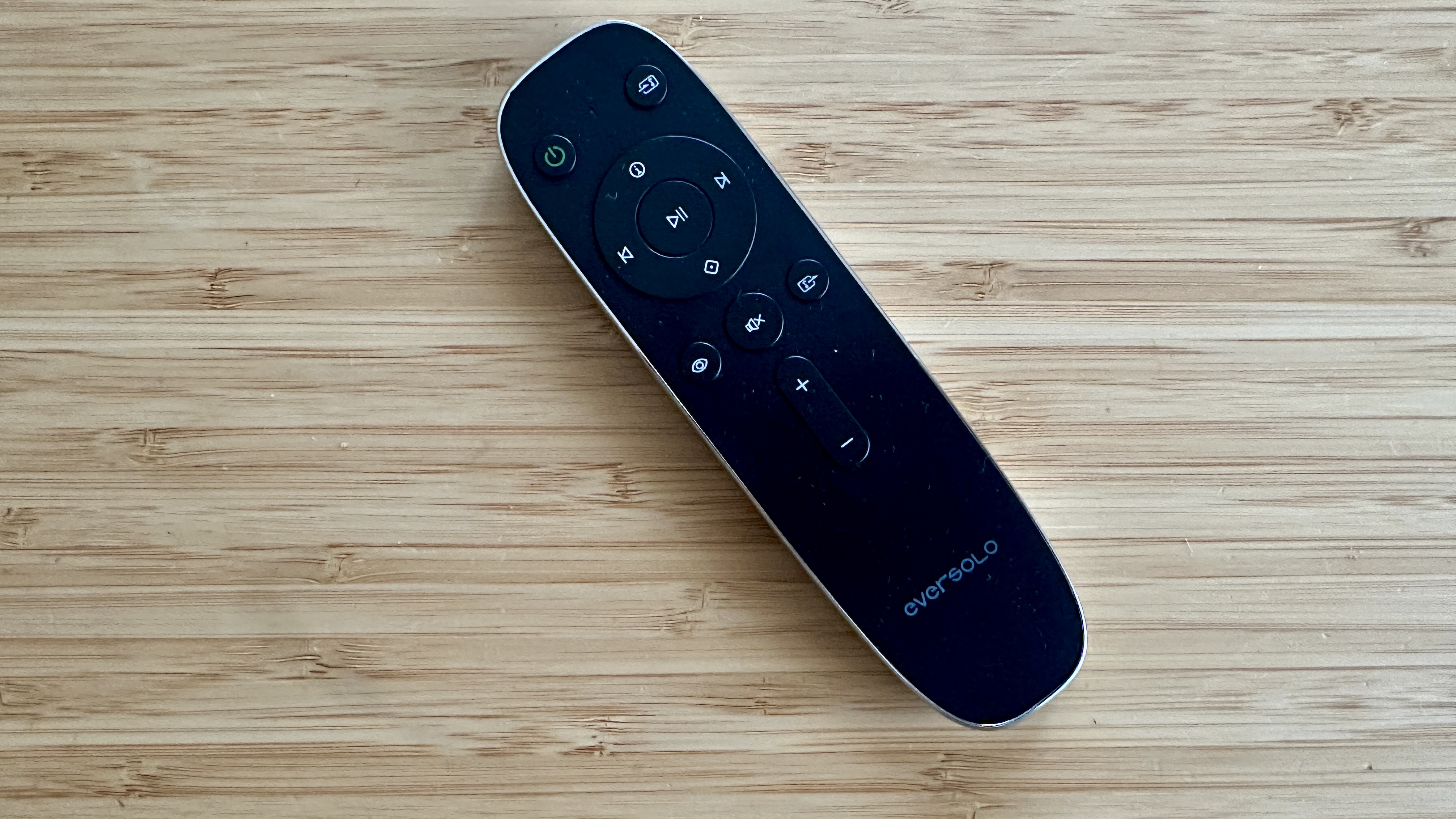
In terms of control, you’ve a gratifying number of well-implemented options. The control wheel, which is a turn/push number, is responsive and reliable, and the same can be said for the weighty little remote control handset that is, in its own way, just as tactile a device as the DAC-Z10 itself. The touchscreen is equally simple and logical to use, and just as reliable in the way it reacts.
Best of all, though, is the ‘Eversolo Control’ app that’s free for iOS and Android. It’s far from the most visually exciting control app around, it’s true – but once you get beyond the relative lack of visual stimulation you’ll find a thorough, stable and eminently useful interface that enables you to control every single aspect of the DAC-Z10’s performance.
- Usability & setup score: 5 / 5
Eversolo DAC-Z10 review: Value
- It costs a lot, but it does a lot
- Performs as well or better than anything else at the same price
- Versatility really adds to its value as a long-term buy
Obviously spending this sort of money on a DAC with preamplification functionality means you have a system that justifies the outlay, and in that case there’s really no arguing with the value for money that’s on offer here.
The amount of things it can do, the range of connections it has, the usefulness of its various control options, and the impeccable quality of its audio mean that its price is very agreeable… to people with this kind of money to spend.
- Value score: 4 / 5
Should I buy the Eversolo DAC-Z10?
Buy it if…
You have digital audio sources that need a proper decoding
Even quite expensive CD players and the like will feel the benefit of the DAC-Z10's audio expression.View Deal
You enjoy a good user interface
The touchscreen and, especially, the control app are as it good as it gets.View Deal
You love a virtual VU meter
Or, even better, a choice of virtual VU meters.View Deal
Don't buy it if…
Graphic design is your passion
The control app may be entirely fit for purpose, but it is tedious in the extreme to look atView Deal
You’re hoping to make an ordinary system sound extraordinary
The Eversolo is not especially tolerant of inferior partners.View Deal
Eversolo DAC-Z10 review: Also consider
Audiolab D9
On a pound-for-pound basis, the D9 DAC/preamplifier is a very decent bet – for a little over half the price of the Eversolo, it gives you a great deal of solid audio competence.View Deal
Chord Hugo TT2
If you’re after something slightly more portable, this an exceptional device – it doesn’t come cheap, though, and it has one of those user interfaces that Chord seems to think is a good idea but the rest of us get madly frustrated by. View Deal
How I tested the Eversolo DAC-Z10
I slotted the Eversolo DAC-Z10 into my reference system – so it took care of the digital-to-analog conversion required by a Rega Apollo CD player, a Naim Uniti Star (meaning internet radio, network streaming and music streaming service content was available), and an Apple MacBook Pro via USB to access digital audio of the highest possible resolution.
It also accepted an analog signal from a pre-amplified Technics SL-1300G turntable. It was connected to a Cambridge Edge W power amplifier via balanced XLR connections, which in turn was connected to Bowers & Wilkins 705 S3 Signature loudspeakers on their bespoke FS-700 S3 stands.
- Read TechRadar's reviews guarantee
- First reviewed: February 2026


Comments
Post a Comment